One Eye
“Are you going to use that?”
One Eye squinted. His right hand hovered over the 45 on his hip. He was deciding.
Marshall Botton stared. To look at him, you’d think he was half asleep, but he wasn’t. At the slightest twitch from One Eye, Botton would snap his own gun out.
One Eye knew that. He knew Botton. From the war. Where One Eye had been shot on the left side of his head.
One Eye remembered. Some of it. He’d heard from … somebody … that a lieutenant or something had pulled him out, wrapped his own shirt around his head, stopped the bleeding.
Coulda been anybody.
But it coulda been Botton.
One Eye’s shoulders unhunched. Botton could tell, and his tension spring loosed a little.
“Nah, I don’t believe this is the good day for that,” One Eye said. “I believe I’ll just move along, ‘f that’s all right with you.”
Botton studied every muscle, every breath, seeing One Eye turn away and start walking. The wind picked up a whisper and a puff of dust brushed his eye, but he didn’t blink. He decided. It was all right with him. Today.
A wooden sign creaked back and forth in the wind. Mitchell’s General.
One Eye’s boots clomped on the boardwalk till he stepped off into the dirt that had mostly dried out after that last storm. He swung up on his horse, kicked it forward a couple steps, then nodded at Botton.
“’Nother time.”
Botton nodded, but watched him ride all the way out of town.

The Walk Home
From Sea Lanes - it never happened collection
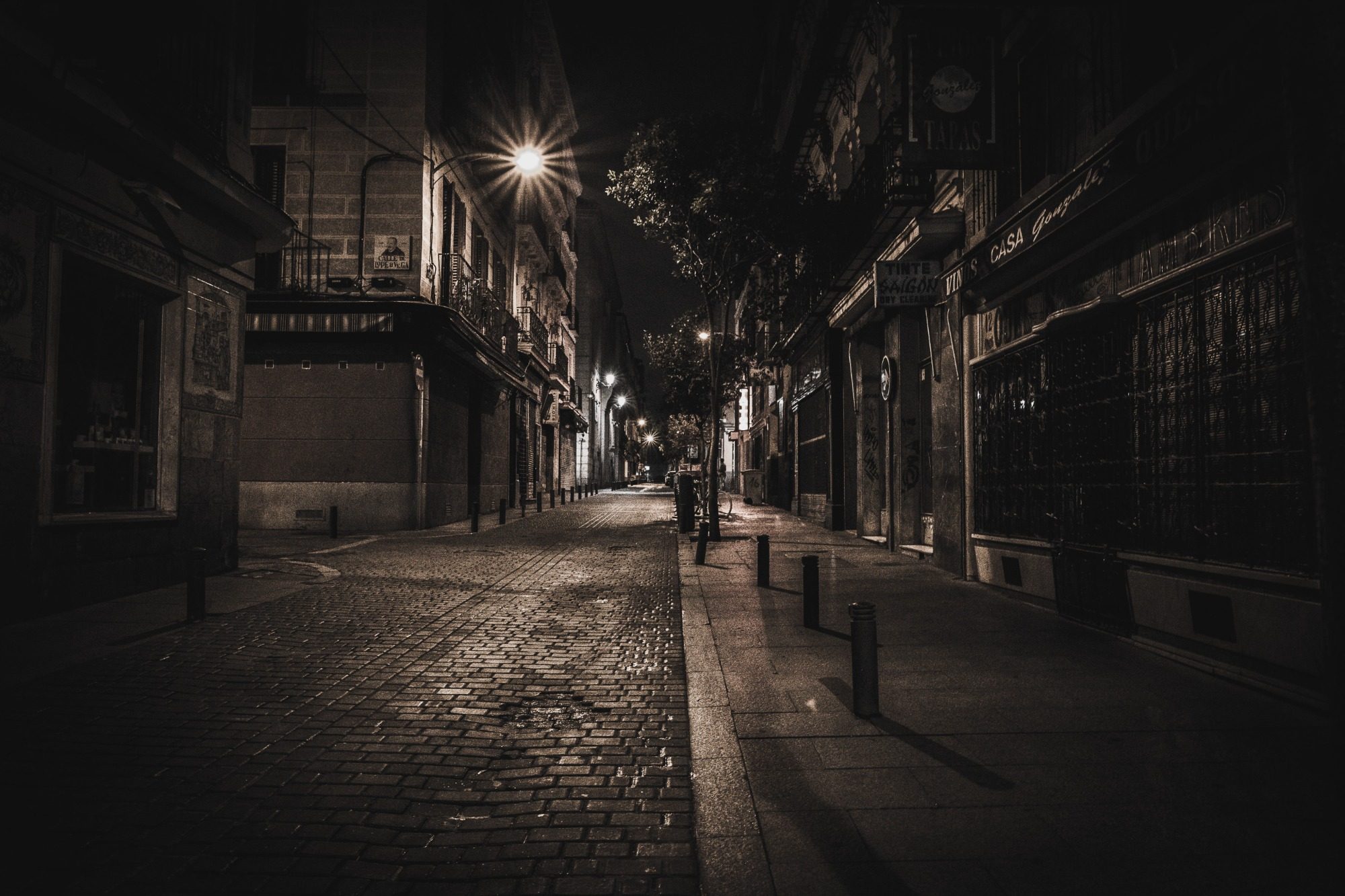
“Man, I’m tired,”
Quincey nodded, rolling her head on her shoulders to work out a kink. “Me too. What time is it?”
Her boyfriend Sam held his arm under a street light. “After midnight.” He smiled at her, noticing again her strength, even after a long day like today. “We better get you home, babe”
She leaned into him a bit more, grabbing his arm and holding it close, only partly because she was a little chilly in the night air.
He undid his jacket button, then wrapped the jacket and his arm around her, as she wrapped her arm around his back.
They’d been working late at the bakery, prepping things for the baker himself to come in to the shop in a few hours and start his day. Every smell of flour and sugar and yeast and warm, well-seasoned ovens lingered on their clothes, and, Sam noticed, in Quincy’s long brown hair. Something else that drove him crazy about her.
There was no one about at this hour, though a few storefronts still showed light inside. People doing the same thing they’d been doing, Quincy figured. Working late, wrapping some things up, prepping other things.
It was a few blocks to Quincy’s small flat, and another five or six blocks to Sam’s. They didn’t live together, but the subject had come up several times. Some days Sam couldn’t think why he insisted on waiting till they were married.
Then again, he hadn’t actually proposed yet.
On a night like this, the air still and quiet, her warmth so close to him, the memory of her smiles and laughs all day long with everyone, Sam felt his mind swirling. He knew he wasn’t thinking straight. He’d just have to lean into his commitment.
Noticing how quiet he was, Quincy said, “You okay?”
He nodded. They walked together a few steps and he realized again he shortened his stride so they would match. He liked walking her home, having her close.
In the distance a dog barked, setting off a relay signal of other barks and yelps. But this was closer. Then they heard the footsteps.
Someone was coming around the corner.
Sam tensed without realizing it and Quincy felt it, and she straightened slightly.
But then an old man walking a tired-looking German Shepherd appeared. He moved slowly and it was immediately clear this was a regular routine for the pair. The leash hung loose, but the shepherd did spot Sam and Quincy and moved to intercept them. But very slowly, very calmly.
Sam pulled his arm from around Quincy and approached the dog, bending over slightly to let him sniff his hand.
“Evening folks,” the old man said, automatically touching the brim of his little hat. His gray hair stuck stiffly out the back and his old worn overcoat showed his slightly hunched shoulders. But he had a nice smile, Quincy thought, and she said, “Evening sir. Beautiful night isn’t it?”
The man lifted his head slightly as though he was just noticing that it was, in fact, a nice night.
He lingered, clearly in no particular hurry, while Sam gave a scratch to the dog’s head, which was well received.
“You folks out for a walk too?” the older gentleman said.
“No, not really,” Sam answered, “just on our way home from work … well … the bakery where we work, just up there a few blocks.”
The man tilted his head. “You don’t mean Ginger’s old place, do you?”
“Ginger?” Quincy said.
“Yes, Ginger. She used to run the bakery on the corner of Maple Glen and Third, up that way.”
Quincy was surprised. “Well, yes that’s the place, but I didn’t know that someone name Ginger owned it. We bought from a Mr. Lapman, just a few months ago.”
The old man’s face took a worried look. “I wonder if I’m remembering right. It was a while ago.”
Suddenly Quincy wanted to reassure him. “I’m sure you’re right. That must have been a while ago, though. How long has it been since you were there?”
Now the worry lines disappeared and a little smile took its place.
“Oh that was a few months, maybe more. Back before my Mary got sick. We’d take Jasper here for an early morning walk and stop there for a coffee and something sweet – a roll or something.”
He paused, obviously remembering, then came back. He smiled. “Yes, I guess that was some time ago. Some of my favorite times, just walking with my Mary, you know.”
Quincy couldn’t help it. “I’m Quincy,” she said, holding out her hand, “and this is my boyfriend Sam.”
“Well, nice to meet you Quincy and Sam. I’m Roger and this, of course, is Jasper.”
Sam gave Jasper another scratch and said to him, “Nice to meet you Jasper.”
Then looking up, he said, “And you too, Roger!” They shook hands, Sam remembering to not squeeze too tightly. A tip his dad had mentioned to him, about how sometimes old folks had arthritis and such.
“Well,” Roger said, “I won’t keep you folks. You probably want to turn in after such a long day. Nice to meet you.” And he touched his hat again.
Sam and Quincy said their goodbyes and turned back down the street. They were quiet the rest of the way to Quincy’s apartment. At the doorstep, they lingered, as usual, but just now, quieter than usual.
“Sam,” Quincy said finally, “I think I know why you wanted to wait.”
Sam took a second to catch up to what she was saying, then held his breath.
“It’s so we can have memories like that someday.”
Sam looked at her, held her, kissed her, and said goodnight.
As he walked away to his place, he began making plans for just how he was going to propose. Something to do with the bakery, he figured.
The Sun Scorched Down On Her Head
From Tracks - it never happened collection
The sun scorched down on her head and her shoulders as she slumped in the boat. She could wiggle only a little, and it didn’t make much difference in the heat.
She’d been breathing as slowly and calmly as she could, trying to conserve her energy.
The boat was small, but it would have been large enough if it hadn’t been nearly totally destroyed by the storm. The upper deck was gone, the cabin torn from the hull. The mast and of course all the rigging had been ripped from their attach points. It was only the natural buoyancy of the hull that had saved her. She’d been able to hold on to a side rail and been tangled in some kind of line during the worst part. When the seas finally settled, she’d been able, barely, to scramble back inside the hull. This morning she’d bailed some of the water out by splashing it with her hands. There was still about two feet of water over her feet.
She had no idea, of course, where she was.
She’d been sailing to Tahiti with the others – she dared not think of any of them just yet – when the storm roared in from the south. In less than an hour, they were all scrambling for their lives. She had clung to the rail as she saw a huge wave throw one of her friends overboard. The next wave did the same. She couldn’t remember any more.
The sun had returned, and the wind was barely there – it didn’t cool her at all.
It was difficult to collect her thoughts, make a plan. The heat burned in.
Must do something. Must see if there is anything in the boat that will help.
She drowsily lifted her head. She was sitting on a cross bracing, her feet on the side of the hull, a few inches above the waterline. She lowered her feet into the water, discovering it to be warm from the sun. There was junk floating around her and she reached for a bottle of something. It was bleach. She couldn’t think, was that useful?
A piece of paper. She fished it out, laid it out on the boat’s rail to dry. Maybe it could be a shade.
She slipped into the water, up to her knees, trying to stand. She shuffled forward, sweeping the water with her hand to see what was under. More paper. She put in on the rail also. Something metal – a can of food! She held it in her hand and kept moving. Then, a pan. Would that help? She tried to think.
Yes! Bail out the water with it. She started immediately, then stopped. With her precarious footing, she almost tipped. She shuffled back to where she’d been sitting and lean against the cross brace. Starting again, she bailed slowly.
After an hour, there seemed to be only a little progress. Why was that?
Maybe a hole in the boat? She fought back a flash of panic.
No. It was just that it was a small pan and a large boat. It would take a while.
She rested, remembered the paper, grabbed it and wondered how she could use it to shade her head. Finally, she thought of a paper hat. She made one as best she could, remembering her childhood attempts.
With the paper hat giving some shade to her face she began again to bail. Slow and steady. When one arm ached, she switched to the other and continued. Before long it was mechanical. Things began to surface inside the boat: boxes, cans.
Good, maybe she could do something with all this debris.
Then it began to rain.
She was annoyed at first, then remembered she needed the water. She took another piece of paper and made a funnel to collect and direct the rain into her mouth. About an hour of her bailing had been nullified by about 15 minutes of rain, but there was nothing she could do.
When the sun finally began to lower, she leaned heavily on the rail watching it. And she saw, floating a little way away, an oar.
How could she get it? Her strength was about at an end, but this was a treasure that could not be ignored. It could save her life, some little voice told her.
She forced herself to the rail, then remembered the lines dangling from the side. She must hold on to them. Slowly, reluctantly she slipped over the side and was immediately jolted by the chill of the water. Paddling feebly, she started kicking towards the oar.
She told herself to pace herself, but the urgency of getting to the oar pushed her. Two more kicks and she grabbed it. It provided a tiny bit of flotation, but with one hand on the boat’s rope and the other on the oar, she could only kick her way back to the boat.
Somehow, she pushed the oar inside. Now to get herself in.
The first four or five times were useless. Her strength was too little to pull herself over the rail. But she did get an idea. She began rocking the boat as much as she could. Timing her kick to when the side nearest her was low, she threw herself as high as could on the rail. Sure enough, the boat-rock lifted her. Inch-worming her way across the rail, she finally reached the tipping point. The boat rocked her inside and she fell face first, scratching and bruising herself everywhere, but at least she was in.
She lay twisted, pushing herself up just enough to lift her face out of the water. With a few minutes more struggling she righted herself, but had nothing left, and fell asleep.
The night was temperate, and though there was a full moon, its light did not rouse her.
Her dreams were strange, falling down hills, sliding down waterfalls, swimming furiously from attacking alligators or something. But she slept.
As the sky lightened in the morning, she woke, remembering in just a few seconds where she was. In a boat, a shell really, in the Pacific, alone.
Surely someone else made it? Murray was a strong swimmer, but then again, he’d need something, some flotsam, to hold onto. Betsy, John, Captain Mike – who knew, but basically it was same story. They would need something to float on. With a great effort, she forced herself up to look over the side of the boat. Was there something, anything, anyone out there? She turned slowly scanning the water, but saw nothing, no debris, no wildlife, nothing.
Think, girl, she said to herself.
Water, you need water.
Now that it was light, she could see better inside her boat and, to her surprise, saw a few things sloshing in the remaining water. There! A can! She struggled on hands and knees further towards the stern and grabbed the can. Amazingly, it was labeled “Water”!
Tears flooded her eyes and she held the can close to her for a moment, then realized she had to open it. As rapidly as it had risen, her spirit sank again.
No, no! She would figure it out. What else was there? After rummaging and splashing from stern to bow, she found: a seat cushion, a towel, some rope, a few more cans (more water and others with the labels gone), a long-bladed knife, and miracle of miracles, a small emergency kit (sewing needles, bandages, antibiotic cream, aspirin, a smaller knife, a small mirror, fishing line and hooks, and four snap-apart lights).
A faint hope returned.


Judgement at the Airport
Jane and Robert almost simultaneously arched their backs, trying to loosen up the stiffness from the brutal plane ride – thirteen hours with only one short stop an hour ago.
This plane was primitive compared to the jumbo jet that had taken them across the Atlantic. This was a tube, with no bulkhead walls to suggest strength and stiffness. The flight attendants smiled as they always did, but they could offer no comfort for the soreness. In fact, they were so used this travel, it never occurred to them to try.
Jane looked at Robert for the thousandth time. He knew what she was thinking. Would it be alright?
Would this work? Would they be able to adopt this child, after all?
All they really knew about him was from the photograph the agency had provided. His cherubic smile had melted their hearts immediately, though they were already softened to the whole idea of cross-cultural, cross-continent adoption.
How many months, years, had it taken to bring them to this spot? Of course they never assumed anything but that they would have kids of their own, the regular way. When a few years passed and nothing happened, they saw the doctors. No problems, just relax, they said. Another couple of years. They started thinking about their options when Jane’s best friend Susan told them about the agency. They were eager to talk to interested would-be parents, and a few month later, here they were, on a plane half-way around the world, bouncing along, worrying and wondering.
His name was Tomas and he was three, a bit small for his age. His parents had died from some disease that had swept through their country, devasting thousands of families. But there were a number of monasteries and convents who’d agreed to take care of the littlest, most vulnerable ones. The government was overwhelmed and glad for the help. Adoption agencies around the world stepped in and began working.
The agency told them they couldn’t really stay in country for long. In fact, everything would have to be handled at the airport. Government officials would be there to verify that everything was proper and legal, and they would only have an hour or two at most to meet Tomas and take care of all the paperwork.
Robert, being the practical one, had been signing papers for days. He’d consulted lawyers, of course, to make sure everything was legal. And then there was the expense. Thousands in legal fees, more for permits, medical checkups, affidavits that proved they were responsible people, able to take care of a child. “Regular parents” didn’t have to go through all this, he grumbled more than once – but only to himself.
Jane was sure the moment they saw the picture and read the little bio. This was him. This was their boy.
A ping sounded on the plane’s intercom. A voice said in several languages that they were approaching the airport, please fasten your seatbelts.
Robert feeling’s immediately swung swiftly between relief (that the flight was over) and fear (what were they in for)? He still harbored an idea that someone would try to cheat them at the last minute, that they would suddenly need lots more money to “settle things”.
Jane, though, found her heart racing. She knew Robert was handling all the paperwork, and frankly, she had pushed all that aside. There was only Tomas and them, heading home, settling him into his new bedroom, finding out what foods he liked, working through the first few days or weeks with clumsy communication as they worked out each other’s language.
The little plane landed with a disturbing rattle, but Robert took a cue from the flight attendants, whom he could see all the way at the front of the plane. They didn’t even blink. In fact, he was sure he saw one yawn.
More instructions came over the speakers, but everyone knew what to do anyway. A din rose, as everyone stood, grabbed their bundles from wherever they’d had them stashed, and gently jostled each other in the aisles.
Jane and Robert only had one bag and Robert grabbed it. He sighed, bracing himself, but felt Jane reaching for his hand and squeezing it tightly.
“It’ll be okay,” he said in a low tone. “We’re almost there!”
Jane smiled weakly, tried to speak but found the words wouldn’t come.
They shuffled down the aisle and through the loading ramp.
They’d been told someone would meet them, but they didn’t know exactly how that was going to happen. Blessedly, there was a nice-looking older woman just inside the terminal holding up a sign with their name.
Robert waved at her and they made their way over. She pulled them aside.
“Welcome, welcome,” she said smiling broadly. “We are so glad to see you. We are so glad you made it. Please, come this way.”
She led them down the main airport walkway a few hundred yards, then finally into a small room off to one side. Inside was a man in uniform and another man in a business suit.
They introduced themselves, but Jane and Robert did not absorb their names at all. The man in uniform asked for their passports, and their papers. The lady who’d greeted them – she repeated her name – took out a large sheaf of papers herself and a few moments went by as the officer and the man in the business suit examined everything.
Robert felt the anxiety rising in him. More paperwork! But then he calmed himself also. It was necessary – just do what was needed.
He glanced over at Jane.
She was clearly not paying the slightest attention to any of this. She only wanted one thing.
“Please,” Robert said finally, “where is the boy? Is he here? Is there any problem?”
The woman smiled again, grabbing both their hands, then releasing Robert’s and grabbing Jane’s with both of hers.
“Don’t be afraid. He’s right here. He’s just in the next room. We must handle all of this first. We want to make sure everything is proper before we bring him in. We don’t want to build his hopes up before we …”
She stopped, and Robert suddenly realized what she meant. There was another person who had to be alright with this adoption. The boy had to want this also. Robert chided himself for forgetting Tomas was probably just as frightened as they were, just as anxious, just as worried.
Finally the officer and the man in the suit seemed satisfied with all the papers. They began stamping various documents, and then said something to the old woman in their own language. She nodded, grinning.
Turning to Jane and Robert, she said, “Come, it’s time to meet Tomas.”
Jane’s heart raced, and she squeezed Robert’s hand so hard it almost hurt, but he only squeezed it back, then put his arm around her.
The old woman opened another door and led them into a little area with a sofa and two large soft chairs. No one was in the room. Jane and Robert instinctively sat on the sofa together. The woman went to another door and knocked on it gently.
It opened and another woman, pretty, dark-haired, appeared, and wrapped around her leg, was Tomas.
He looked frightened, confused, unsure, and held onto the young woman as she shuffled them into the room.
Without even thinking, Jane slipped off the sofa onto her knees, and held out her arms.
Tomas looked at her.
Suddenly his face lit up and he rushed over to Jane, who wrapped him in her arms and began weeping for joy.
The two women also had tears in their eyes.
It took a moment for Robert to realize he hadn’t been breathing. Then he too slid down on the floor and embraced his wife and their new son.
His new family.
The flight home lasted only minutes.
From Sky Trails - it never happened collection
.
Got a comment? Add it here.
Dictum quam nulla
Telephone: +1 555 123 456 789
E-mail: email@example.com
Address: 2148 Street Name, City Name, County, 92103